Prologue
In a universe much like our own, a blue planet of breathtaking beauty circles its star amid the invisible folds of spacetime. There, billions of human beings live in perfect and enduring harmony. Yet it was not always so.
For millennia, human history was ruled by persistent, almost instinctive violence. At the dawn of civilization, clans and tribes fought over territory and vital resources. In time, fortified villages, cities, kingdoms, nations, and empires arose. Hatred of those who were different, greed, anger, and envy fueled a spiral of warfare that drove the creation of ever deadlier weapons.
There were two wars on a planetary scale; each left scars that could never be erased. And when a third global conflagration threatened to extinguish all life, something extraordinary happened. Against all odds, an unprecedented event took place that forever altered the destiny of the species.
That unexpected turning point came in the year 2050 CE, and the humans who inhabit this world today remember it by a solemn name: “the Great Change.”
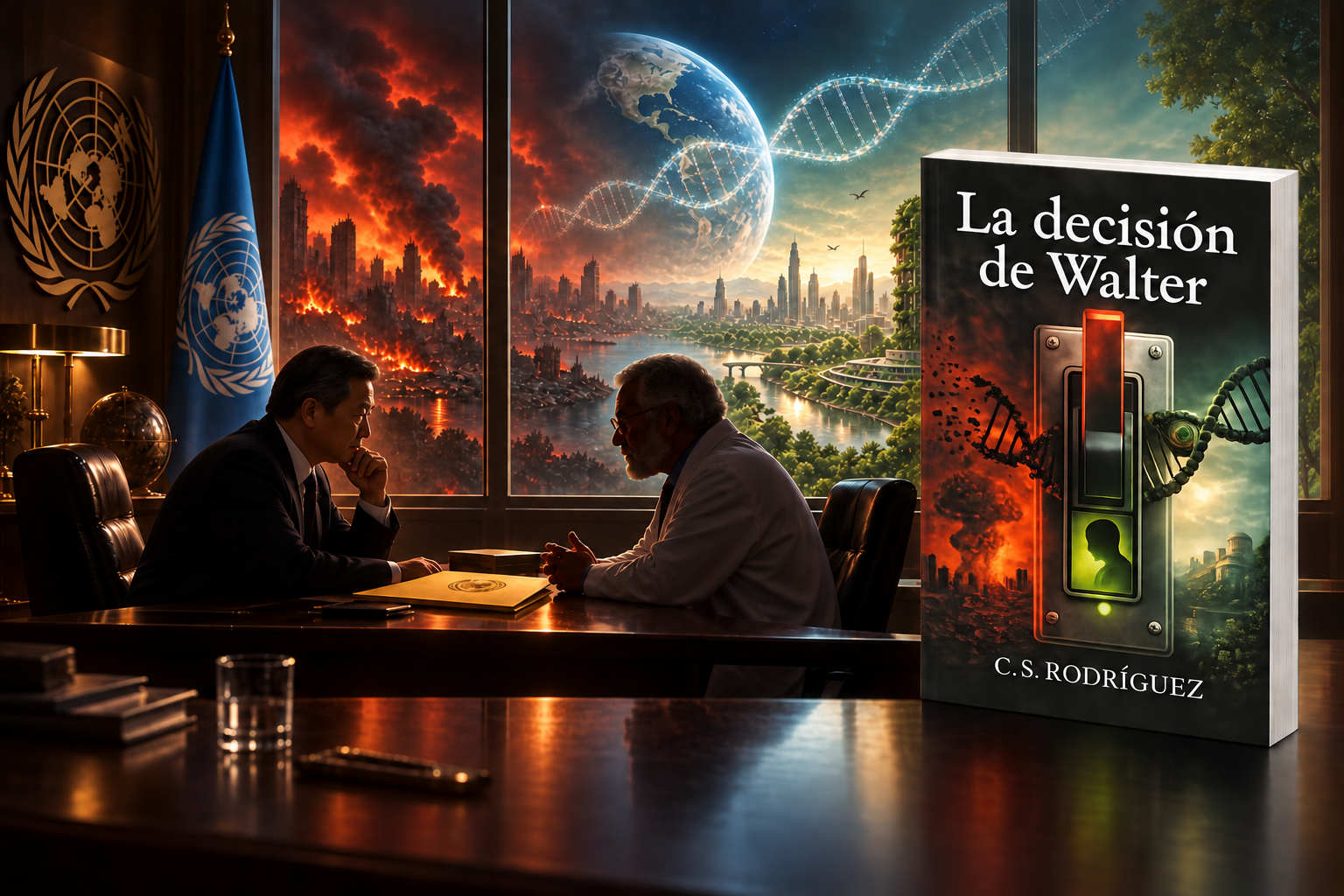
At the beginning of that year, Walter Chen, Secretary-General of the United Nations, lived in a state of constant tension. The planet was hurtling toward an irreversible conflict. International alliances trembled like glass on the verge of shattering, the rhetoric of world leaders grew more ferocious, and fear permeated the air like an invisible gas.
At five o’clock that afternoon, Walter was due to meet Dr. Albert Narrow, a retired scientist once hailed as one of the most brilliant virologists and geneticists of the twenty-first century. To some, he was a visionary genius; to others, a dangerous madman. After leaving Stanford in 2040, shortly after receiving his second Nobel Prize, Narrow had vanished from public life.
The call had been brief, but charged with urgency. Narrow had insisted vehemently that the meeting take place at once. There was a restrained tremor in Albert’s voice that had not escaped Walter’s notice.
The scientist arrived fifteen minutes early. He paced the elegant anteroom, mentally rehearsing how he would present the plan he had spent more than a decade developing. His steps were measured, but his hands betrayed a nervous impatience.
When he entered the office, Walter received him with a mixture of skepticism and curiosity. The doctor was noticeably thinner, his cheekbones sharply defined, his gray hair disheveled. Yet his eyes retained the piercing quality that, years earlier, could disarm a panel of scientists. Albert, for his part, found the Secretary-General distracted, as though part of his mind remained trapped in some crisis room.
After a brief greeting, Albert drew breath. Before he began, he warned Walter that what he was about to propose would require an open mind and the suspension of any hasty judgment.
“Allow me to begin with a question,” he said, fixing his eyes on Walter’s. “What would you be prepared to do to avert the imminent planetary war? You know full well it would mean the end of everything we know, don’t you?”
The silence that followed was dense. Walter held his gaze, slowly leaned back in his black leather chair, and motioned for him to sit on the red sofa reserved for guests.
The initial distance between them fell away.
“Nothing would please me more than to prevent it; that much is obvious. I assure you, I am doing everything possible… and even the impossible, if such a thing exists,” he joked, with a half smile that never reached his eyes.
“I don’t doubt it,” Albert replied with a slight incline of his head. “But what I bring you is no ordinary plan. It is a project my team and I have worked on for years.”
Albert placed a yellow folder on the desk. Walter looked at it without opening it and kept the conversation on course.
“Tell me,” he said. “How can your project help resolve the present crisis?”
“The process I am about to describe would change everything on a global scale. But once begun, there would be no turning back. Nothing would ever be as we know it again.”
Walter frowned.
“Please get to the point. I am a very busy man,” he said, casting a quick glance at the gold clock hanging on the wall opposite him.
Albert took a deep breath.
“Since the beginning of time, humanity has been chained to its darkest side. It has caused incalculable suffering. The most powerful among us, often operating from the shadows, have moved the world as though it were a puppet theater.”
“For God’s sake! I don’t need a history lesson or a moralizing sermon.”
“Very well. But please, let me continue,” the scientist said.
“Go on.”
“We have concluded that the true root of suffering is not poverty, or ignorance, or corruption: it is written into our biology. Human genes harbor patterns of aggression, tribalism, and contempt for those who are different. Please, take a look at the documentation.”
Walter regarded the folder warily, as though it contained an invisible threat. He drew a deep breath, rubbed his eyes with both hands, and finally opened it.
Inside were reports, laboratory analyses, brain scans, and genetic maps. Everything converged on an idea as ambitious as it was disturbing: the creation of a virus capable of reprogramming human behavior at its biological foundation.
“This is not about education or legislation,” Albert said. “It is about reprogramming.”
Walter turned the pages with mounting unease. The virus acted upon a specific network of genes linked to aggression, dominance, and empathic indifference. It altered the expression of certain neurons in the amygdala and prefrontal cortex, drastically reducing responses associated with reactive violence while enhancing empathy and rational thought. The modification would also be heritable.
Walter set the report down on the desk as though it had burned him. This was more than a biotechnological tool. It was a moral bomb, a point of no return.
“Imagine a world in which the darkest instincts had been eradicated from human biology,” Albert proposed, his voice measured. “A planet where violence, resentment, anger, hatred, and evil vanished at a stroke. Even from the minds of our leaders.”
Walter did not answer at once. He closed the folder with deliberate slowness and slid it to one side, as though he needed to put some distance between himself and it.
“Over the past few decades, it has been shown that there are no ‘evil genes’ as such. Human behavior is a complex mosaic: education, environment, personal history… What the hell are you talking about?” he asked, frowning once more.
“I am not talking about some magical mutation that turns people good,” Albert replied, unruffled. “This is not about selecting individuals, but about redirecting, on a global scale, the impulses driving us to the brink of self-destruction.”
Walter looked at him distrustfully.
“What do you mean?”
“Think of chimpanzees. Violent, hierarchical, possessive. Now think of bonobos, their genetic cousins. Peaceful, cooperative, resolving conflict through touch and social bonds. Do you believe that comes from their environment? That it is a matter of culture? No. It is biology. It is their genetic programming. And ours can be rewritten too,” he added, with a smile he could barely contain.
Walter took another deep breath. Something churned inside him, somewhere between fear and fascination… But his voice hardened.
“Do you realize what you are proposing?” he asked coldly, as though speaking to a fanatic. “Do you have any idea what unforeseeable consequences a genetic modification of that magnitude could have… on a global scale?”
“I understand perfectly,” Albert replied with unsettling calm. “I have devoted the past several years to perfecting the design, thanks to funding from great fortunes. We have detected no serious side effects. The trials with primates were conclusive. And with humans… even more so.”
Albert did not flinch. On the contrary, his eyes shone as though he had just revealed a truth long held within.
“Of course. Every great revolution carries risks. In the early trials,” the scientist continued, “some subjects exhibited a slight loss of individual initiative. Others did not react to injustice, as though all conflict had become intolerable to them. But we have corrected those effects. The system has been refined. We are ready to act.”
The Secretary-General could scarcely believe what he was hearing. The situation was critical, yes, but never could he have imagined finding himself confronted with such a proposal. He tried to calm himself and made a conscious effort to keep an open mind.
“And what do you want from me?” Walter asked, his voice icy.
“We could set the plan in motion without your cooperation,” Albert replied, “but your support would be crucial. Your direct access to world leaders would serve as a catalyst for change. Large-scale genetic modification could produce adverse effects in the short and medium term—not only in politics, but also in the economy, in international relations, and, of course, in people’s everyday lives together.”
“You are completely detached from reality,” Walter retorted.
“I don’t believe so. All I ask is that you consider it calmly. We need you to facilitate dialogue with heads of state and mitigate the collateral effects of the change. We have a detailed road map, but complications will arise that we cannot even anticipate and will have to manage as they unfold.”
Walter reflected for several seconds. Countless scenarios paraded through his mind. And in some of them—to his surprise—that deranged plan might not be the worst option.
“If we were not standing on the brink of the abyss, I would order your immediate arrest.”
“That would not be a good decision for anyone,” Albert replied with the same composure.
Walter sighed again, visibly exhausted.
“What would happen if you released this viral vector? Would people change immediately? What would the practical consequences be?”
“The process would begin about two weeks after the virus was released,” Albert explained. “Imagine it: terrorists ceasing to believe that their cause justifies killing; world leaders sitting down to negotiate instead of threatening one another; entire societies placing the common good first. Hatred would disappear. Cultural, religious, and ideological impositions would come to an end…”
Walter fell silent, confused and disoriented. He was trapped at a crossroads where no path seemed safe. His moral principles wrestled with the disturbing yet seductive logic of what he had just heard.
“I have a question,” he said at last, looking at Albert gravely. “Have you tested this on yourselves? Or did you consider it too dangerous to risk your own lives?”
“My entire team, along with those who financed the project, underwent the modification months ago.”
Walter Chen raised his eyebrows in disbelief.
“We have also experimented on rival fundamentalist groups, terrorists, violent people consumed by hatred for others, ethnic groups that were killing one another… and the results have been astonishing. You cannot begin to imagine… You can see it in the reports I brought you.”
“Without their consent?” Walter snapped. “Without any choice?”
“Did the children born in war zones have a choice? The planet’s millions of refugees? The victims of abuse, of genocide, of corrupt systems? They did not choose either. They merely suffered the consequences.”
Walter rose abruptly and walked slowly toward the window. The setting sun stained the buildings on the horizon orange, but he scarcely noticed. Each step seemed to weigh more heavily upon him. The air in the room had grown thick, almost unbreathable.
“There is something you are failing to consider,” he said at last, his voice low and almost hoarse, still without turning. “What if we also eliminate the capacity to rebel? To question? To dissent? What kind of humanity would we be creating?”
Albert did not move. His answer came with the same calm that had sustained him throughout the conversation, but now his tone carried a gravity bordering on the solemn.
“One that can survive,” he said.
Walter did not turn immediately. He kept looking out over the city as though he expected the world itself to offer him an answer. The rooftops, the trees, the illuminated streets… Everything seemed peaceful. And yet he knew that peace was a fleeting illusion, sustained by fragile agreements, unstable leadership, and a humanity poised on the brink of collapse.
At last, he drew a deep breath, as though trying to inhale something more than oxygen. As though he might also draw in a little courage.
“If I decide to help you,” he said at last, turning slowly toward Albert, “if I were even to consider it… can you guarantee that we would not be turning into the very thing we claim to be fighting?”
Albert did not answer at once. He rose with the composure of a man who had spent years preparing for that conversation.
“The only thing I can guarantee is that if we do nothing, everything will disappear. History will not repeat itself again, because there will be no one left to repeat it.”
Walter looked at him. There was no arrogance or elation in the scientist’s eyes, but something far more disturbing: naked certainty. A faith without cracks.
And for the first time in his life, Walter Chen—the man who had negotiated with dictators, signed treaties amid wars, survived a thousand crises—did not know whether he should fear more what would happen if he said yes… or what would happen if he said no.