THE JUST CAUSE THAT NEVER ENDS
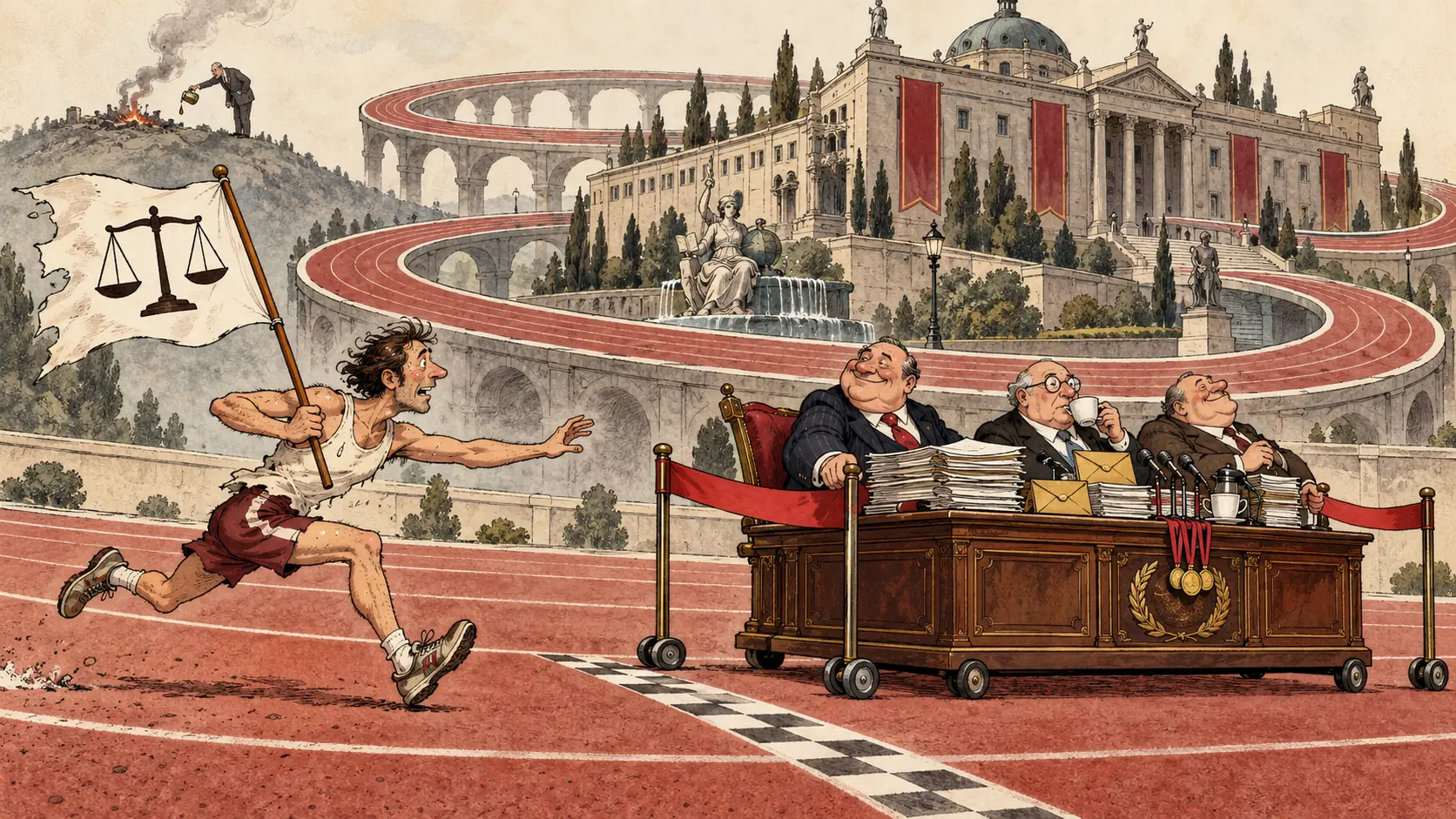
Without organised movements, many injustices would remain untouched. Defending a cause requires time, knowledge, money, leaders, associations and people professionally devoted to it. Spontaneous outrage may start a protest, but it is unlikely to reform laws, maintain services or change a society’s customs over decades.
Up to that point, there is nothing especially absurd about it.
The nonsense begins when the success of the cause threatens the survival of the organisations created to defend it.
While the problem remains serious, the two aims coincide: the larger the movement grows, the greater its ability to combat the problem. But once it achieves a substantial part of its objectives, a contradiction emerges. Acknowledging success would mean admitting that so many posts, departments, grants, conferences, advisers, observatories, campaigns and experts are no longer needed.
Victory for the cause can become professional defeat for those who make a living from it.
It then becomes tempting to discover that the problem was far deeper than it first appeared. Major abuses decline, but subtler ones emerge. Conduct once regarded as secondary acquires unexpected gravity. The meaning of words expands, the boundaries of injustice advance, and the final objective retreats whenever society draws near to it.
There is no need to imagine a conspiracy meeting in a secret room. People may act with complete sincerity. Someone who has devoted their life to fighting a problem learns to see it everywhere, associates mainly with those who share that diagnosis and builds around it their identity, their reputation and, sometimes, their livelihood.
Their interests and their convictions eventually point in the same direction.
Sociology has long studied this mechanism. In the early twentieth century, Robert Michels formulated the so-called “iron law of oligarchy”: even organisations founded on democratic and egalitarian ideals tend to develop professional leaders, hierarchies and groups that control resources and internal communication. Robert K. Merton later described “goal displacement”: rules and structures created as means eventually become ends in themselves, to the point that preserving the organisation may matter more than fulfilling the mission that justified its birth.
The cause then ceases to have an organisation.
The organisation begins to have a cause.
Feminism allows us to observe this tension with particular clarity.
Its earliest demands denounced explicit and easily identifiable forms of discrimination: preventing women from voting, studying, managing their property, entering certain professions or acting legally without a man’s authorisation, as well as the terrible physical and psychological violence inflicted within relationships.
In many countries, those barriers were removed and formal equality advanced extraordinarily. That does not mean that every objective has been achieved or that discrimination has disappeared. Nor is the situation the same throughout the world: many countries still have laws that restrict women’s rights, and grave problems of violence, coercion and legal inequality remain.
But that is precisely why we should distinguish between the serious problems that persist and the institutional need to keep finding new ones.
Feminism is not a single organisation, nor do all its strands behave in the same way. Nevertheless, part of the movement has become institutionalised within public administrations, universities, trade unions, political parties, media organisations, consultancies and professional associations. Academic research itself has examined how this institutionalisation has brought feminism into mainstream politics, but also how professionalisation can generate new hierarchies, dependence on funding and changes in its objectives and strategies.
When thousands of people have a job, a career or a public position tied to the permanent existence of sexism, expecting all of them to announce spontaneously that the problem has diminished and that part of the structure can be dismantled would place rather too much faith in human nature.
It is far more likely that the definition of the problem will change.
The fight against impunity for brutal male violence can end up meaning that a mere argument lands a man in a police cell. Legal discrimination may give way to statistical inequality; that, in turn, to everyday behaviour; then come micro-sexism, words, gestures, explanations, the position of one’s legs or the distribution of characters in a film. Some of these matters may deserve reflection. The exaggeration lies in presenting them as equivalent stages of the same historical oppression and using any difference between men and women as automatic proof of discrimination.
The smaller the problem, the greater the effort required to make it visible.
There may also be resistance to acknowledging any progress. If it is admitted that a society has improved greatly, the sense of emergency weakens. Inequality must therefore be described as structural, ubiquitous and capable of reproducing itself even when the laws are equal and most people openly reject discrimination. The enemy no longer needs to manifest itself through a prohibition: it may hide in a custom, a preference, a statistic or a phrase whose true meaning can be recognised only by someone versed in the theory.
The cause thereby becomes impossible to satisfy.
If a woman chooses a traditional course of action, she may be said to have internalised the patriarchy. If she chooses the opposite, she proves that she is freeing herself from it. If she denies feeling oppressed, her very denial may be used as evidence that the oppression runs especially deep.
A theory that interprets every outcome as confirmation no longer risks being wrong.
Nor does it risk ever ending.
Christianity offers a different historical example. It did not begin simply as a modern humanitarian association, but as a diverse religious movement born in the Jewish world and spread throughout the Roman Empire. Its followers were persecuted intermittently and, during certain periods, with enormous severity. In its first centuries, Christians were a minority demanding the freedom to practise their faith and presenting themselves as a moral community set against imperial power.
The situation changed radically in the fourth century. Constantine granted the Church tolerance, property and legal and tax privileges, while also intervening in its internal disputes. Under Theodosius I, Nicene Christianity eventually became the Empire’s official religion, and a formerly persecuted faith became closely linked to political power. Bishops acquired public standing, social authority and the ability to influence even emperors.
Religion did not disappear when it ceased to be persecuted.
It became an institution.
From then on, defending the faith could also mean defending property, hierarchies, privileges, courts, offices and political authority. At various points, the Church that had asked for tolerance went on to persecute heresies, restrict other beliefs and demand not only spiritual but also social obedience. A doctrine founded around a transcendent truth could not declare its work complete, because there would always be souls to save, errors to correct and enemies of the faith to contain.
An institution that represents God has an additional difficulty in recognising that it may already possess too much power.
This does not turn the whole of Christianity into a self-interested operation, nor does it erase its moral, cultural or charitable influence. Likewise, recognising the institutionalisation of feminism does not invalidate all its demands. The problem is not that a cause grows, organises itself and survives. The problem arises when its structure is shielded from any assessment of its results.
Environmentalism displays a similar evolution, although it too should not be oversimplified. It emerged in response to extraordinarily visible problems: rivers turned into rubbish dumps, unbreathable air, industrial waste discharged without control, species wiped out and companies able to pass their environmental costs on to society as a whole. The creation of environmental laws, agencies and movements achieved improvements that now seem so normal that we forget why they were necessary.
The fact that some problems have been reduced does not mean that the environmental question has been resolved.
Once major polluting industries are regulated, attention may shift to the drinking straw, the bag, the shower, one’s diet, holidays or individual guilt. The citizen ceases to be someone expected to support reasonable policies and becomes an environmental sinner who must demonstrate purity through small renunciations.
Some of those behaviours have real consequences. What is absurd is losing all sense of proportion and treating every gesture as a decisive battle for the survival of the planet.
Another consideration is that the Earth’s climate has always changed for natural reasons: orbital variations, solar activity, volcanism, oceanic changes and internal mechanisms that interact with one another. Some are well understood; others only partially so, and it would be arrogant to claim that present-day science has identified every component of such a complex system.
Reconstructions of the climate before the instrumental era are not exact photographs of the past either. They are produced using tree rings, ice, sediments, corals and other indirect indicators. They reveal trends and approximations, but they contain uncertainties about the dates, temperatures and geographical extent of episodes such as the so-called Little Ice Age.
None of this invalidates current climate research. Greenhouse gas concentrations can be measured, their physical behaviour is known, and the available studies attribute most —and, in their central estimate, virtually all— of the net global warming observed since the late nineteenth century to human activity.
But a central estimate is not a divine revelation.
The IPCC itself —the United Nations Intergovernmental Panel on Climate Change, which reviews and synthesises the available scientific research— works with probability ranges and acknowledges limitations in models, in the representation of natural variability and in our understanding of certain mechanisms. It does not claim to possess a perfect machine capable of reproducing every ocean current, every atmospheric interaction and every possible factor still unknown.
There are therefore two opposing exaggerations. The first is to deny any human influence because the climate was already changing before industrialisation. The second is to present current estimates as though they had permanently closed off every possibility of revision and allowed us to determine with mathematical precision the exact percentage attributable to each cause.
Science should be able to say: “This is the explanation that currently fits the observations best, and this is our margin of uncertainty.”
Religion begins when that sentence is replaced with: “The matter is settled, doubt is immoral, and any policy proposed in our name is scientifically proven.”
Criticising vested interests does not refute the science.
But science does not sanctify every interest that speaks in its name either.
The same phenomenon appears in opposing ideologies. A nationalist movement may arise to achieve independence and, once it has done so, need internal enemies or external threats to justify its leaders remaining the permanent guardians of the homeland. A party created to restore order may discover that the country is never orderly enough.
A revolutionary organisation may claim that the transition to freedom still requires another decade of dictatorship. “The provisional dictatorship” is the most extreme version of the never-ending cause.
The Soviet Union provides one of the clearest examples. After the 1917 Revolution, the Bolsheviks dissolved the elected Constituent Assembly in January 1918 when it refused to accept the primacy of their government. The suppression of critical newspapers was initially presented as a temporary measure, but it became permanent policy. Even the Cheka, the political police force created in December 1917 as an extraordinary institution that was supposed to disappear once the regime had consolidated, gave way to a succession of repressive bodies that accompanied the Soviet state for decades.
The transition required a temporary police force.
What proved temporary was the name of the police force.
The mechanism does not belong exclusively to the revolutionary left. After Chile’s 1973 coup d’état, the Military Junta’s first communiqué justified the intervention by invoking the country’s crisis and stated that it intended to restore “order and institutional normality”. The regime led by Augusto Pinochet remained in power for seventeen years. In 1988, the plebiscite did not merely ask how to end the dictatorship, but whether Pinochet should remain in power for another eight years; the majority voted no.
The provisional mission of restoring the institutions had lasted almost two decades and was still asking for an extension.
Not every leader needs to lie from the outset. Some may sincerely believe that they will remain only for as long as strictly necessary. The problem is that power changes both the circumstances and the person who wields it.
At first, the ruler sees himself as a servant duty-bound to hold office. Then he discovers that he is the only person capable of maintaining stability. Later, he concludes that those who wish to replace him are not merely opponents, but a threat to everything that has been achieved. Finally, protecting the country and protecting his own power become one and the same thing.
An entire structure also grows around the leader and depends upon his continuity: ministers, soldiers, police officers, judges, propagandists, favoured businesspeople and civil servants who have taken part in decisions that are difficult to explain. For all of them, the end of the regime may mean losing their jobs, influence, assets or immunity from prosecution.
Power does not merely occupy an office.
It constructs a building whose occupants are afraid of being left out on the street.
The more abuses committed during the provisional period, the more dangerous it becomes to leave it behind. A government that has imprisoned opponents, censored newspapers or used public funds to reward loyalty no longer regards an election as a simple change of administration. Defeat may open archives, investigations and court proceedings.
At that point, remaining in power ceases to be merely an ambition.
It becomes a defence mechanism.
Hitler’s case is different, but it reveals another version of the same danger. It is not accurate simply to say that “he won an election and became a dictator”. The Nazi Party received the most votes, but Hitler did not win an absolute majority in a free election, nor was he directly elected chancellor. President Paul von Hindenburg appointed him chancellor on 30 January 1933 through the constitutional procedure, while conservative politicians believed that they could control him from within the government.
The mistake was not merely that many citizens supported him.
It was also that the elites thought they could lend him power without losing control over it.
After the Reichstag fire, the regime suspended fundamental freedoms and persecuted its opponents. In March 1933, the so-called Law to Remedy the Distress of the People and the Reich, known as the Enabling Act, was passed. It allowed the government to enact laws without parliamentary approval and even to depart from the Constitution. The vote took place while numerous Communist and Social Democratic deputies were detained, in hiding or prevented from attending, and under intimidation by Nazi forces.
The law was, at least on paper, to remain in force for four years. Hitler claimed that he would use those limited powers only when the emergency required it. It was extended in 1937, extended again in 1939 and declared permanent in 1943. By then, no independent institutions remained capable of refusing its renewal.
Provisional rule had fulfilled its principal function: lasting long enough to destroy everything capable of keeping it provisional.
Hitler demonstrates that the danger does not necessarily require a military coup. A democracy can also be dismantled from within when its institutions hand exceptional powers to someone who intends to use those powers against them. Legal mechanisms do not make every result achieved through them democratic. A parliamentary majority may pass the very law that strips Parliament itself of power.
The door to a dictatorship may be broken down. It may also be opened with a perfectly lawful key.
That is why it is not enough to ask whether a ruler came to power legally. What he subsequently does to the courts, the press, the opposition, elections and the rules that allow him to be replaced matters too. Democracy is not merely about entering government correctly; it is also about keeping open the genuine possibility of leaving it.
Nor should we fall into the childish error of thinking that the danger depends solely on ideology. The left may justify concentrating power in order to achieve equality. The right may do so to restore order, defend the nation or stop a revolution. A religious movement may promise to guard morality until society recovers its values. A technocratic government may suspend politics until citizens learn to vote responsibly.
The causes change.
The final sentence sounds much the same: we still cannot give power back to you.
Every ideology possesses a supreme good capable of justifying the wait. The problem is that, when no effective limits exist, defending that good ends up depending entirely on those who have proclaimed themselves its guardians.
There is no need to believe that everyone who acquires power inevitably becomes a monster. It is enough to recognise how readily human beings justify what benefits us. A ruler may begin by saying that his presence is necessary and end by sincerely believing that his departure would be irresponsible.
Power does not corrupt only in the crudest sense of enrichment or abuse.
It also distorts perception.
Someone who has spent years surrounded by subordinates may confuse obedience with respect, propaganda with support and the absence of protest with satisfaction. The less he listens to his opponents, the more irrational they appear. The more power he possesses, the more evidence he finds that he deserves to possess it.
Ideologies disagree about paradise. They often agree that the time to relinquish power has not yet arrived.
The mechanism may be found even outside politics. A company hired to solve a problem does not always have an incentive to eliminate it completely if doing so ends the contract. A department created to manage a crisis will seek new functions when the crisis ends. An expert may be honest while interpreting the world in a way that confirms the importance of their field.
When a problem feeds a structure, the structure begins to feed the problem.
This does not mean that we should dissolve every organisation after its first victory. Many achievements can be reversed, and some institutions are needed to ensure that they are preserved. A fire brigade should not disappear simply because there are no fires today. But it should be able to show that it prevents and extinguishes fires, rather than endlessly broadening the definition of fire until it includes any rise in temperature.
A healthy cause should be able to set verifiable objectives, acknowledge progress, distinguish serious matters from secondary ones and admit that some of its structures are no longer necessary. It should also allow its leaders to be criticised without treating that criticism as a betrayal of the people it claims to protect.
Above all, it should be able to imagine its own success.
When an organisation cannot describe any circumstances in which it would reduce its budget, its power or its presence, we can no longer tell whether it wants to solve the problem or administer it for ever.
Just causes may need institutions.
The danger begins when institutions need injustices.
A genuine victory allows us to celebrate that there is less work left to do.
An industry built around a cause, by contrast, cannot afford to win.