MIGRANTS, AN AUDACIOUS STUPIDITY
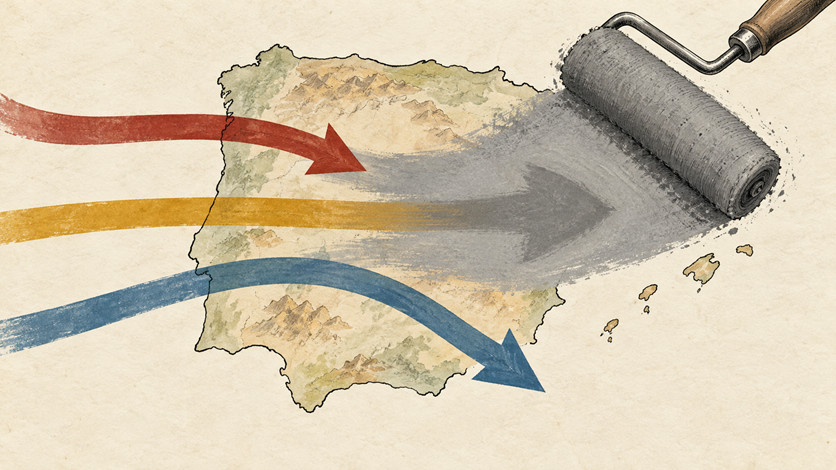
There is nothing wrong with the word «migrant». On the contrary, it is useful precisely because it is broad. A person who leaves one country and travels towards another is migrating, and we often do not yet know where that person intends to settle. Imagine a man who leaves Morocco, enters Spain and plans to continue to France to live there. From the Moroccan perspective, he is an emigrant; during his journey, we can accurately describe him as a migrant or, if we want to be more precise, as a migrant in transit through Spain. When he reaches France intending to settle there, he will be an immigrant from the French perspective.
Up to that point, there is nothing particularly absurd.
The problem begins when we give exactly the same description after changing only the ending of the story. Suppose that the man crosses the Strait because he wants to settle in Madrid, work here, rent a home here and build his life here. From the Spanish perspective, he is then an immigrant. He is also a migrant, naturally, because he has migrated, but «immigrant» adds information that the more general word does not contain: Spain is not merely one stage of the journey, but the place to which he has come to settle.
It does not seem like a particularly complicated distinction, yet we have managed to turn it into something almost ideological.
—Three hundred immigrants have arrived.
—Migrants.
Ah.
Sorry.
We would not want the direction of movement to be politically incorrect.
There is a perfectly reasonable explanation for using «migrant» when someone has just entered Spain and we do not know their intentions. We do not know whether they plan to stay, continue to France, join relatives in Germany or decide later. In such cases, using the more general term avoids attributing a destination that we do not know. It is a sensible linguistic precaution.
What is strange is turning that precaution into a habit that survives even after we know where the person lives.
That raises a fairly elementary question: why must we be so careful not to assume that someone has come to Spain to stay, yet have so few reservations about using a word that permanently leaves open the possibility that Spain is merely a place they are passing through?
If we do not know the person’s destination, let us say «migrant». Fine. But if someone arrived five years ago, works in Madrid, has children who study here and is trying to regularise their residence so that they can continue living in Spain, perhaps we can risk suspecting that they are not crossing our country on their way to Lyon.
That person is an immigrant.
And there is absolutely nothing wrong with that.
The word contains no moral judgement. It does not mean criminal, poor, illegal, ignorant or dangerous. An Argentinian neurosurgeon who settles in Barcelona is an immigrant; so is an American businesswoman who opens a company in Málaga, a Moroccan waiter in Madrid or a Colombian teacher in Valencia. «Immigrant» does not explain what kind of person someone is. It explains the perspective from which we are describing a population movement.
That is precisely why different words exist.
A Spaniard who leaves Madrid to settle in Berlin is an emigrant from the Spanish perspective and an immigrant from the German one. We can call that person a European migrant without saying anything false, but we will have removed a relevant part of the information. If two million young people left Spain tomorrow, it would be rather peculiar for the television news to announce that «two million Spanish migrants are participating in international mobility processes». It would be an impeccable, modern and extraordinarily uninformative sentence.
We would probably prefer to be told that two million Spaniards had emigrated.
Because we would immediately understand what was happening.
The same applies in the opposite direction. If hundreds of thousands of people arrive intending to settle in Spain, we are talking about immigration. We may consider that immigration necessary, beneficial, excessive, insufficient or badly managed; we may debate integration, employment, housing, public services, borders or regularisation. Those are separate debates. But it is difficult to understand why conducting them politely requires us to begin by eliminating the very word that describes the phenomenon.
Here we encounter one of those small contemporary habits that I find fascinating: confusing a more general word with a necessarily better one.
«Migrant» seems more neutral because it does not place the camera at either particular end of the journey. We observe a person moving across the map and avoid deciding whether we are viewing them from the country they are leaving or the country they are entering. That neutrality can be useful, but it carries an obvious price: the more general a word is, the less information it provides.
A cardiologist is a doctor. A whale is a mammal. A violin is an instrument. An immigrant is a migrant.
We can always replace a specific category with a general one without necessarily making an error. What is less clear is whether we have improved the language.
If someone enters a restaurant and says, «I was served by a human being», the statement will probably be correct. But perhaps «waiter» would allow us to understand the scene a little better.
Something similar happens with «migrant». Sometimes it is exactly the word we need; at other times, it is used as a kind of terminological detergent intended to clean another word that has acquired unpleasant connotations. It is understandable. «Immigrant» has been uttered too often alongside prejudice, suspicion and generalisation, which may explain why some institutions, media outlets and individuals prefer a term they perceive as carrying less baggage.
The intention may be good. The method is more debatable.
If a society despises a group of people, changing the noun rarely eliminates the contempt. It normally transfers it to the new noun. For a while, the new word appears clean, modern and respectful; then someone begins using it disparagingly, it accumulates the same connotations and we must find another one.
Today, «migrant» may sound more considerate than «immigrant». If those who despise foreigners begin speaking contemptuously about «migrants» tomorrow, we will have to replace that word too. Perhaps «person in a situation of human mobility» will then emerge, an expression long enough to keep xenophobes away for a couple of weeks.
Then we will start again.
Perhaps it would be more effective to teach people that there is nothing wrong with being an immigrant.
For long periods, Spain was a country of emigrants before also becoming a country that received immigration. Millions of families have a story about someone who left, someone who arrived or both. We do not appear to need to conceal either direction in order to respect those who travel along them.
It would be another matter to use «immigrant» as a synonym for «person who has just crossed a border irregularly». That would also be inaccurate. An immigrant may have arrived by plane with an employment contract, be studying for a master’s degree, have had legal residence from the first day or have been a naturalised citizen for twenty years. Likewise, not everyone who enters Spain is necessarily an immigrant: a tourist is not; someone merely passing through is not either; and a person whose true destination is another country may be described far more accurately as a migrant in transit.
The solution, therefore, is not always to use «immigrant».
It is to use words according to what we know.
Perhaps that is too revolutionary a proposal.
If we do not know where someone intends to settle, «migrant» is an excellent choice. If we know that they are crossing Spain on their way to another country, «migrant in transit» is even clearer. If they leave Spain to settle abroad, we are talking about an emigrant. And if they arrive from another country to build their life here, «immigrant» describes the situation perfectly.
Spanish already had words for all of that before we discovered the need to correct it.
What is truly curious is that contemporary linguistic sensitivity may end up producing precisely what it supposedly seeks to avoid: less precision. We avoid a word because we believe it may be uncomfortable and systematically replace it with another that encompasses different situations. Thus, someone who disembarks today without yet knowing where they will end up, someone else who crosses Spain to join their family in France and another person who has lived in Seville for twelve years can all end up becoming the same thing: «migrants».
Correct.
But remarkably uninformative.
And perhaps that is the problem with much politically sanitised language. It does not usually lie. It merely blurs. It replaces a specific word with a broader one, a clear reality with a less committal formulation, and then presents that loss of information as a moral improvement.
We do not need to do that.
We can defend the dignity of immigrants by calling them immigrants. We can demand that they be treated as people without pretending that we do not know whether they have come to stay. We can regard immigration as positive and continue using the word «immigration». In fact, that would probably be much healthier: an adult society should be capable of discussing a phenomenon without first having to rename it to prevent someone from feeling uncomfortable.
So, the next time the television news reports on «migrants arriving in Spain», there will not necessarily be anything wrong with it. We may not know their destination, in which case it is the perfect word.
But we can also ask ourselves one very simple question:
Are they passing through Spain, or are they coming to live in Spain?
Because if we know that it is the latter, there has long been a perfectly normal and precise word for it.
«Immigrants».
You can say it.
Really.
Nothing happens.