Choosing those who govern us is not a matter of hiring someone for four years. It means entrusting them with the power to pass laws, manage resources, lead institutions and make decisions whose consequences may still affect our children long after that politician’s face has disappeared from every campaign poster.
It would therefore be desirable for our leaders to be good people.
But that is not enough.
A person can be honest, generous towards their neighbours, loving towards their children and genuinely concerned about others, yet still defend ideas capable of ruining the economy, weakening institutions or turning society against itself. Good intentions do not correct bad diagnoses or prevent the consequences of a misguided decision.
A leader can increase poverty while trying to protect the poor, destroy jobs while attempting to defend workers or restrict freedom in the belief that they are creating a fairer society. They can also harm businesses while claiming to be saving the economy, curtail rights in the name of security or abandon vulnerable people because they believe every individual should solve their problems without help.
Being wrong with good intentions is still being wrong.
That possibility exists on the far left, the far right and at every point in between. No ideology has a monopoly on goodness, intelligence or stupidity. Every party can contain decent people with dangerous ideas, brilliant people with few scruples and mediocre people who have learned how to deliver convincing speeches.
So far, nothing particularly absurd.
The nonsense begins when we choose our leaders as though we were deciding which contestant deserves to win a reality television show.
We focus on who we like, who speaks like us, who insults their opponents most wittily or who best embodies the character we want to support. We confuse intelligence with verbal agility, talent with charisma and goodness with the ability to become emotional in front of a camera.
If the candidate also despises the same people we despise, they may seem even more intelligent.
Recognising a good leader is not easy. The media decide which events to show us, how to present them and how much time to devote to each one. Algorithms feed us messages similar to those we liked yesterday. Our family, education, surroundings and different political subcultures provide us with different ways of interpreting the same facts.
Two citizens can look at the same politician and see completely different things. One sees strength where the other sees authoritarianism. One hears social awareness; the other, economic irresponsibility. One admires the politician’s ability to defend their convictions; the other fears their intolerance.
There is no foolproof detector for dangerous leaders.
But there are warning signs.
The first is offering remarkably simple solutions to highly complex problems. Unemployment, housing, immigration, crime, inequality and the sustainability of pensions all depend on numerous factors and force us to choose between alternatives with different costs. Anyone who claims to be able to solve them with a single measure may not have understood the problem—or may be counting on their voters not understanding it either.
Cutting every tax does not guarantee prosperity. Raising them does not guarantee excellent public services either. Increasing every sentence does not automatically eliminate crime, just as explaining its social causes does not protect victims. Banning dismissals does not create jobs, and liberalising every market does not ensure that everyone can gain access to it.
Public policies produce side effects, incentives and costs. An intelligent leader acknowledges them. A demagogue conceals them and promises that only «other people» will pay.
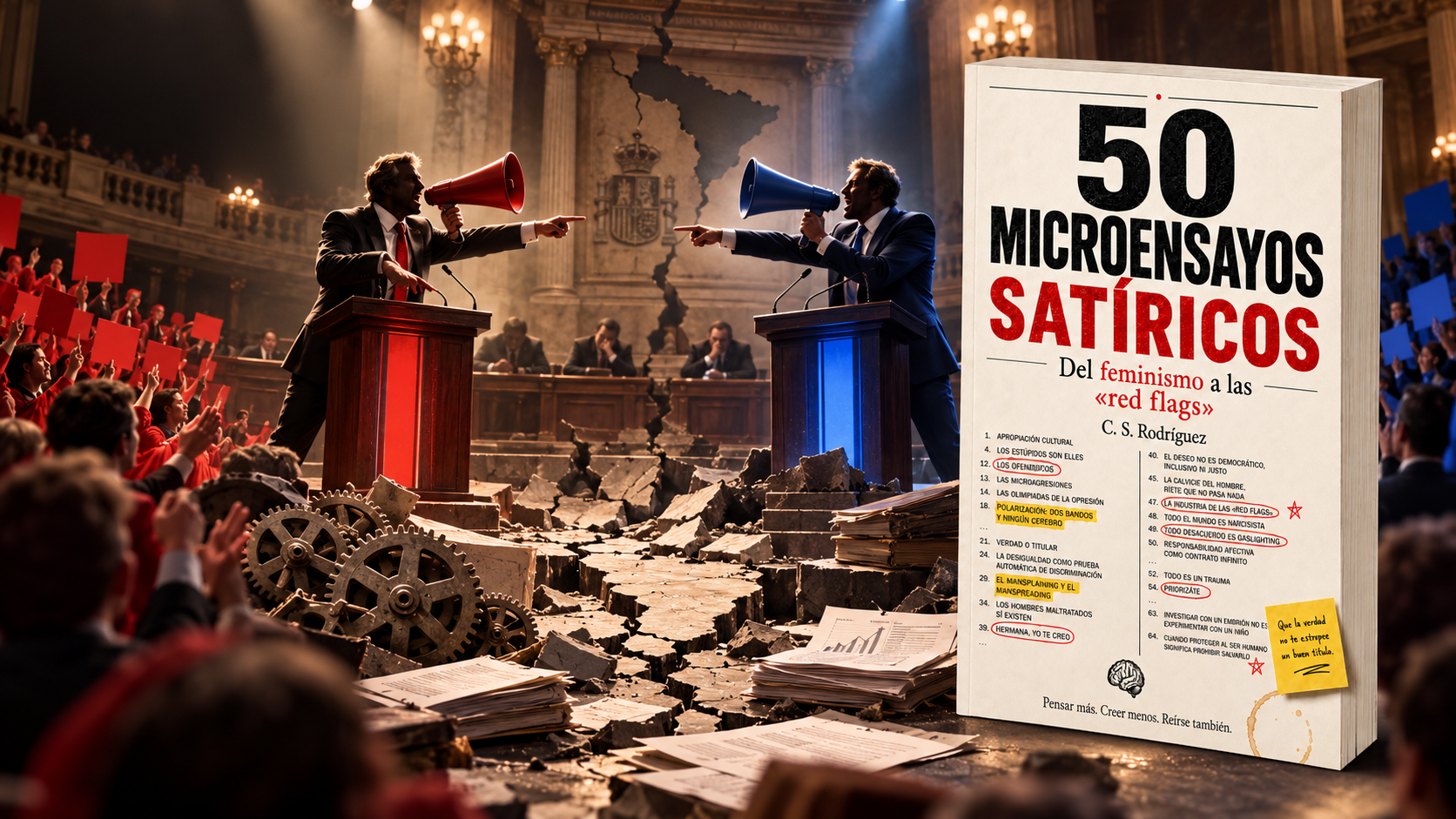
The second warning sign is the constant need to divide.
Men against women. Landlords against tenants. Business owners against workers. Rich against poor. Civil servants against the self-employed. Immigrants against native-born Spaniards. Madrid against Barcelona. León against Valladolid. Bilingual regions against regions with only one official language.
Any difference can be turned into a moral frontier.
Some are persuaded that others intend to stop them from speaking their co-official language. Others are told that Spanish is going to be driven out of their own homeland. Regional rivalries, cultural differences and historical grievances are exploited until citizens facing similar problems come to regard one another as enemies.
This does not mean that the conflicts are imaginary. There are competing interests, genuine inequalities and legitimate disagreements. The problem arises when the politician makes no attempt to resolve them because they need to preserve them. If two groups reach an understanding, they no longer need the saviour who promised to protect one from the other.
A dangerous leader always needs someone to blame.
If housing is expensive, either landlords are entirely to blame or protected tenants are. If wages are low, either all business owners are exploiters or all workers are unproductive. If there are problems with integration, either every immigrant is a threat or any criticism of a cultural practice is xenophobic.
Reality loses its nuances because nuance makes it harder to shout slogans.
Another warning sign appears when disagreement ceases to be regarded as an error and becomes a moral failing. Anyone who does not support the programme is no longer merely mistaken: they are a fascist, a communist, a traitor, a parasite, one of the privileged or an enemy of the people.
The message is usually reduced to a threat:
«Us or destruction.»
The candidate does not ask us to compare proposals. They demand that we choose between them and the apocalypse. If they lose, another party has not won legitimately: the enemies of the country have prevailed, along with the ignorant, the manipulated or those who wish to destroy democracy.
Curiously, they all claim to be saving it.
We should also be wary of anyone who never acknowledges doubt, error or cost. Governing means making decisions with incomplete information and changing course when the results contradict the forecasts. A leader who is incapable of saying «I don’t know» will not be able to say «I was wrong» either. They will need to manipulate the data, blame their predecessors or invent an enemy to explain why their perfect plan has produced a disaster.
Political intelligence does not mean always being right.
It also means detecting mistakes quickly and correcting them before they turn into catastrophes.
That is why labels matter less than the way power is exercised. A leader can defend firmly conservative, social-democratic, liberal or environmentalist ideas without treating those who disagree as enemies. They can also call themselves a centrist while governing with arrogance, incompetence and contempt for institutional constraints.
Moderation does not mean always positioning oneself halfway between two opinions. If one person says that two plus two equals four and another insists that it equals six, the moderate answer is not five. Being moderate means accepting that one may be wrong, respecting the legitimacy of one’s opponents, refusing to use hatred as an electoral weapon and understanding that governing a country is not the same as conquering enemy territory.
We may vote for different parties because we want different models of society. Some will prefer lower taxes and greater private initiative; others, broader public services and greater redistribution. There will be disagreements over education, the environment, territorial organisation, immigration and social customs.
That is part of democracy.
What should not be part of it is the obligation to hate one another.
The majority has the right to elect governments and determine the direction of many public policies, but not to decide which citizens deserve dignity. A democracy does not force everyone to live according to majority customs. It creates a common framework within which different ways of life can coexist, provided that they respect the rights of others.
Nor does this mean that every idea and form of conduct is acceptable. Respecting a person does not require us to consider everything they do respectable. Child abuse, violence, coercion and exploitation do not become cultural choices merely because someone tries to justify them as such. Pluralism ends where serious harm to another person begins.
But between imposing a single morality and accepting every form of behaviour lies an enormous space: the place where free societies live.
Naïve do-goodism can also be dangerous when compassion refuses to examine its own consequences. Defending people who struggle to find housing does not require us to portray illegal occupation as a harmless way of life or to make every property owner responsible for solving the shortage of public housing. Some of those who enthusiastically justify illegal occupation would probably discover a few nuances if someone occupied their own home.
Ideas tend to seem nobler when someone else bears their cost.
But condemning that naïve do-goodism does not justify the opposite extreme either. Defending private property does not permit us to abolish legal safeguards, ignore situations of vulnerability or treat everyone involved as identical criminals. Cruelty does not become realism simply because it mocks compassion.
An intelligent leader distinguishes between cases. A dangerous one needs them all to look the same so that the same slogan can be applied to everyone.
How, then, should we choose?
We can look at whether candidates explain the costs of their proposals as well as the benefits. Whether they surround themselves with competent people who are capable of contradicting them. Whether they respect institutional checks when those checks limit their own power. Whether they change a measure that is not working. Whether they can defend their voters without denying the rights of those who will never vote for them.
We can also ask what they need from us in order to secure our support.
Do they ask us to understand a problem or to hate someone? Do they offer us difficult decisions or an easy scapegoat? Do they treat us like adults, or promise that everything can be solved without effort, without sacrifice and without anyone from our own group having to pay anything?
Goodness matters. Intelligence and talent matter too. But all three qualities must be accompanied by prudence, respect for limits and the ability to accept reality when it contradicts ideology.
We do not all have to vote for the same party. Nor would that even be desirable. Among the choices closest to our values, we can choose those who have the least need to divide us in order to govern.
A country does not need a saviour.
It needs leaders intelligent enough to know that they are not one.