There are general knowledge questions, and then there are questions about current politics.
What is the capital of Italy? — Rome.
How many ministries does Spain have? — Wait a moment while I check.
After all, there may have been a cabinet reshuffle this morning, a minor coalition party may have demanded another portfolio, or someone may have discovered that they have spent years without becoming a minister despite thoroughly deserving it.
In Spain, knowing how many ministries there are requires up-to-date information. Having studied is not enough. Even having studied yesterday is not enough.
A ministry can disappear, merge with another, split in two or rise from the dead under a slightly different name. A secretariat of state can be promoted to a ministry, and a directorate-general can become a secretariat of state. Sometimes a word is added. Sometimes one is removed. Sometimes so many words are included that the department’s name ends up resembling the summary of an election manifesto.
Reorganising the public administration is not necessarily foolish. Societies change, new needs emerge and certain responsibilities acquire an importance they did not previously have. It would be absurd to preserve for ever a structure designed for a country that no longer exists.
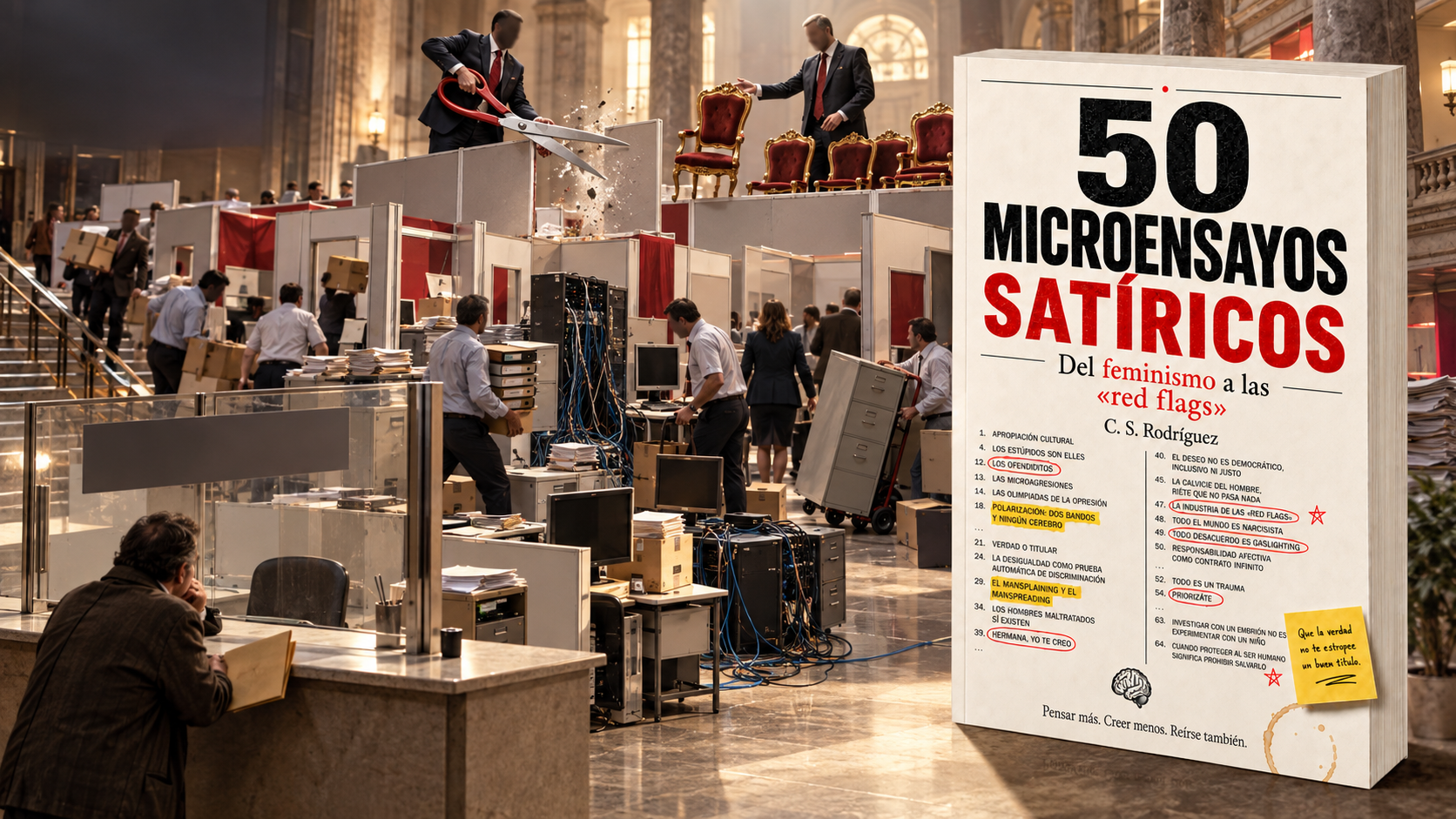
The nonsense begins when the organisational chart ceases to be a tool serving the administration and becomes the seating plan for a wedding reception.
This party needs three chairs.
That leader wants to sit close to the top table.
This other one refuses to be seated by the door.
No problem. Where there used to be one ministry, there will now be two. Let us multiply portfolios like the loaves and fishes. One for you, another for your coalition partner and, if negotiations become difficult, we can always create the Ministry of Important Affairs, Urgent Challenges and Coalition Balance.
Everyone is happy.
Well, everyone except the public administration.
From the outside, creating a ministry may look simple. Its name is announced, someone is appointed to run it, a plaque is replaced and a social media account is opened. There: we have a ministry.
But a ministry is not a minister.
Nor is it a building, a logo or an official account with a flag beside its name.
A ministry is an organisation made up of thousands of people, responsibilities, procedures, budgets, contracts, software applications, archives, databases, management bodies and years of accumulated knowledge.
It cannot be divided by drawing a line on a sheet of paper.
When a ministry is split in two, someone must decide which employees go where, who keeps the files, how the budgets are divided, which body assumes each responsibility, which applications each department will continue to use and who will take responsibility for contracts that are already under way.
Permissions, access profiles, inventories, online portals, citizen services, digital signature systems, archives, websites and databases must also be separated. While all this is happening, the administration must continue operating as though it were not being dismantled from within.
Citizens cannot wait six months because no one has yet decided which ministry is responsible for their case.
A company cannot be denied a grant payment because the directorate-general processing it has changed its name, reporting line or building.
A civil servant cannot reply:
—Sorry, your application is currently somewhere between two ministries. Please come back when the move is over.
Although sometimes that is precisely what is happening.
The regulations reorganising the departments must themselves provide for transitional periods during which the old services continue working for the new ministries. That is perfectly logical: a ministry can come into legal existence in a single day, but it takes much longer to establish its bodies, allocate its staff and take control of its technical systems.
It is born with a name, but without a nervous system.
Every ministry must also have an undersecretariat. It may sound like just another bureaucratic term, but this is the structure that supports much of the department’s everyday work. It handles matters such as human resources, internal organisation, budgets, material resources, legal advice and information-systems planning.
If we create a ministry, we must provide it with all that machinery.
If we divide one, we must decide how to divide its machinery as well.
And if we merge two, duplication appears—and it does not magically disappear when a royal decree is published in Spain’s Official State Gazette, the BOE.
Suddenly there are two staffing structures, two ways of working, two sets of applications and two teams accustomed to solving the same problems differently. Someone will have to decide which one remains, which one changes and what happens to those who have spent years performing those functions.
On paper, «personnel» are redistributed.
In reality, people are moved.
People who understand a particular subject, set of procedures and collection of applications because they have worked with them for years. Civil servants who know which exception applies to an unusual case, whom to ask when a problem arises and why a procedure was designed in a particular way.
That knowledge does not always appear in the manuals.
Sometimes it exists only inside the head of someone who has spent fifteen years dealing with a particular matter and will now be transferred elsewhere because, after the merger, two civil servants are responsible for something that can have only one person in charge.
The chosen one stays.
The other takes their experience to a department where it may be of no use whatsoever.
Their place may be taken by someone perfectly capable who simply does not know that particular field. They will have to learn. They will make mistakes. They will need time. They will ask the person who left—if they can still find them and if that person is not too busy trying to understand their own new job.
The administration will have achieved something extraordinary: two good civil servants learning tasks they had already mastered.
Information technology deserves a chapter of its own.
Every department uses applications, networks, databases and procedures adapted to its responsibilities. Separating or merging those systems may require data migrations, new developments, changes to permissions, amendments to contracts and months of coordination.
What amounts to moving a rectangle around an organisational chart in a political office can become a nightmare lasting several years for an IT team.
Naturally, the regulation may declare that the reorganisation will not result in any increase in public spending.
The BOE will accept many things.
What it cannot do is decree that thousands of hours of work never existed.
The cost of creating a ministry is not confined to the salary of the person running it, their advisers, private office, official cars or institutional photographs. The greatest cost may be the time during which hundreds or thousands of public employees stop improving services because they are busy reorganising them.
That is time not spent simplifying procedures, correcting mistakes, updating applications or assisting citizens.
It is lost productivity.
It is wasted knowledge.
It is a public administration condemned to rebuild itself continually instead of improving itself.
Citizens rarely see where the problem originated. They merely notice that their case is delayed, that two bodies contradict each other, that an application does not work or that nobody knows for certain which department is responsible.
Then they blame the civil servant who answers the telephone.
Meanwhile, the politician who decided to reorganise three ministries to make a coalition agreement work is already on television announcing another historic transformation.
Is there an alternative?
Yes: agree on a basic, sensible and stable structure for Spain’s General State Administration.
I said «agree».
I know—it sounds like science fiction.
The main political parties could reach a consensus on a distribution of ministries designed according to administrative criteria and maintained through changes of government. A government could alter priorities, budgets and policies without dismantling the structure responsible for implementing them.
Because governing differently does not necessarily require renaming every building.
That organisation would not have to be immutable. New realities could emerge that justified a change. Artificial intelligence, for example, might require a secretariat of state to coordinate the work of different ministries. In other cases, creating a directorate-general or assigning new responsibilities to an existing one would be enough.
But every new problem does not need its own ministry.
Elevating a subject within the administrative hierarchy should depend on its complexity, the volume of work it generates and its importance to the country—not on the need to find someone a ministerial portfolio.
Major changes should be accompanied by a public justification: which organisational problem they are intended to solve, how much the transition will cost, how staff will be distributed, which IT systems will be affected and what specific improvement is expected.
And after a while, someone should check whether that improvement actually occurred.
If the reorganisation does not increase effectiveness, reduce costs, simplify procedures or improve public services, perhaps it was never an administrative reorganisation at all.
Perhaps it was merely political decoration.
Ministries belong to the State, not to the government temporarily occupying them. Their structure should respond to the country’s lasting needs, not to the fleeting balance within a coalition, a president’s friendships or the professional ambitions of someone who considers a secretariat of state beneath them.
A ministry should not be a prize.
Nor should it be compensation.
Still less a chair manufactured when there are no longer enough chairs to go around.
Changing a plaque is easy.
Making a public administration work well requires decades of stability, experience and continuous improvement.
So when the answer to the question «How many ministries does Spain have?» depends on the week in which it is asked, perhaps the problem is not that citizens do not understand the organisational chart.
Perhaps the problem is that the people designing it do not know what it is for either.