THE TERRIBLE CRIME OF PINK AND BLUE
There is a reasonable side to this concern. For a long time, boys and girls were not merely offered different toys or clothes: they were also given different expectations. Girls were expected to be pretty, caring, delicate and obedient. Boys, strong, brave, competitive and unemotional.
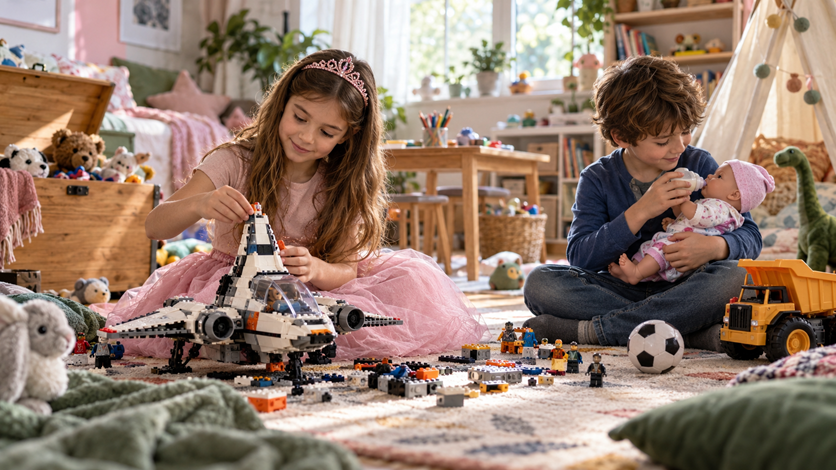
There is nothing absurd about making sure that a girl can play football, build a spaceship or dress up as a pirate. Nor is there anything absurd about allowing a boy to look after a doll, dance, cry or take an interest in activities traditionally regarded as feminine.
Expanding possibilities is a form of freedom.
Up to that point, there is nothing particularly absurd.
The nonsense begins when fighting a stereotype means banning or looking down on everything that happens to fit it.
Then, giving a girl something pink stops being an aesthetic choice and begins to look like an attempt to smuggle patriarchy into her cot.
As if a pink onesie could turn her into a submissive woman.
As if a doll could prevent her from studying engineering.
As if watching a princess film could determine her future relationships with men.
Toys and role models naturally have an influence. But influencing does not mean programming. A girl’s personality is not determined by the colour of her pyjamas, just as a boy’s personality is not fixed forever because someone gives him a toy truck.
Human beings are somewhat harder to programme than a washing machine.
The contradiction appears when we argue that children should choose freely, but only regard a choice as free when it challenges the stereotype.
If a girl wants to play with cars, she is breaking down barriers.
If she prefers dolls, perhaps she has been conditioned.
If she does not want to wear dresses, she is showing personality.
If she loves princesses, someone will suspect that she has not yet discovered her true interests.
The emancipated girl must choose freely, provided that she chooses what the progressive adult expected her to choose.
But freedom does not mean preventing a girl from wearing pink.
It means allowing her to wear pink, blue, black or green without anyone using it to decide how she should think, work, love or live.
The same thing happens in the opposite direction. Some traditional parents are perfectly happy for their son to play with cars, footballs or toy guns, but become alarmed if he asks for a doll, a toy kitchen or a pink T-shirt.
In both cases, the problem is the same.
The child’s choice is not supported.
Adults make sure that the child chooses correctly.
Clothing exposes the inconsistency even more clearly. We are repeatedly told that clothes have no gender and, in theory, a skirt should not be considered more feminine than trousers, nor trousers more masculine than a skirt.
Nevertheless, society has quite easily accepted women wearing trousers, suits, ties, combat boots, loose shirts or very short hair. A woman can look modern, elegant, attractive or simply normal.
Going in the opposite direction remains far more complicated.
A man who turns up at an office wearing a skirt, tights, heels, a handbag and a blouse designed for women will probably receive stares, jokes and questions about his sexuality. And not only from conservative people.
Many people who claim to have overcome stereotypes would not choose that man as a partner either, nor would they react with complete naturalness if the person dressed that way were their own son.
We have accepted women incorporating masculine elements because masculinity can still raise their status: it conveys authority, confidence or independence.
But a man who adopts feminine elements may be seen as ridiculous, weak or less attractive.
That reveals an uncomfortable contradiction.
We say that femininity is worth just as much as masculinity, yet we still regard it as degrading for a man to move too close to the feminine.
The girl in trousers has gained a freedom.
The boy in a dress remains a social experiment.
We should also avoid the opposite exaggeration. The fact that a boy and a girl show different preferences does not automatically prove that everything comes from biology. But neither do we need to claim that every difference has been manufactured by advertising, parents or patriarchy.
Preferences may arise from a mixture that is difficult to disentangle: temperament, imitation, upbringing, environment, identification with other children and personal tastes.
We do not need to settle the entire nature versus nurture debate before buying a birthday present.
We can offer variety without turning every toy into an ideological statement.
We can give a child a doll as well as a construction set.
We can let a girl want to be an astronaut and a princess in the same afternoon.
We can accept that a boy plays football and lovingly looks after a doll without preparing a report on his future identity.
Childhood should be a space for trying things, not a laboratory in which every choice is interpreted as a symptom of oppression or resistance.
A toy can teach, influence and awaken interests.
But it does not write the destiny of the person who receives it.
The fight against stereotypes makes sense when it opens up possibilities.
It becomes nonsense when it replaces an old obligation with a new one: before, the girl had to wear pink; now, she must avoid it to prove that she is free.
Sometimes, a pink dress is just a pink dress.