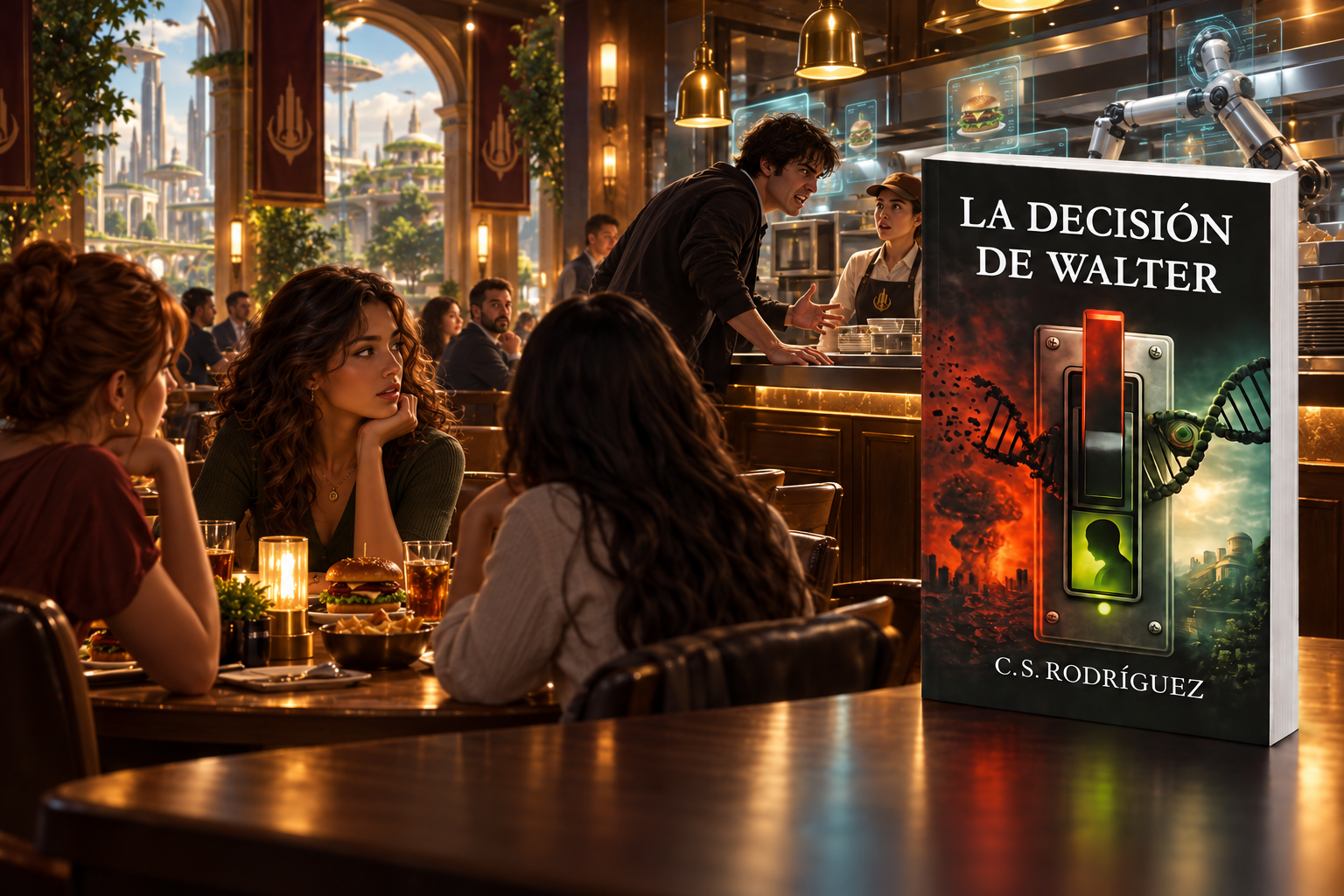
Year 1001 of the Planetary Era
A millennium after “The Great Change”. Some forty-five billion people inhabit the planet, living in peace under a single administration: the Global Government.
Among them is Xara, a twenty-one-year-old in her first year of a History of Civilisations degree. She lives with her father, Robert, who is eighty-three. Ever since she was a little girl, she has been fascinated by delving into the vast wealth of information held in the Global Network’s virtual libraries and researching the planet’s past.
In her spare time, she reads or listens to old computerised books and pores over audiovisual material, photographs and ancient documents that help her imagine the lives and aspirations of the people featured in them centuries ago. She is keenly aware that those people were very different, for they lived before “The Great Change”, and that is precisely why she is so eager to understand them. Most were anonymous figures who could never have imagined that their lives would arouse such curiosity nearly a thousand years after their deaths.
Since childhood, she has enjoyed long weekly conversations with her father about her latest discoveries and takes enormous pleasure in his masterful lessons. Robert is an enthusiastic researcher and a professor in the Faculty of History at the General University of Toledium. There is no doubt that she has inherited his passion for understanding humanity’s past; indeed, hers is even greater. The era surrounding “The Great Change” is her favourite period in all of human history, as well as the one she has studied most extensively and knows best.
A new day dawns in Toledium, the city where Xara has lived with her father since childhood. It lies in the region of Iberia, within the territory of Uropia. Like the rest of the planet, it is peaceful, green and clean. The city sprawls across a vast area where streets lined with bioclimatic homes mingle with broad-canopied trees bearing edible fruit, fertile gardens tended by agricultural drones and a diverse array of leisure and service establishments.
The city runs entirely on renewable energy generated by thin-film photovoltaic sheets, deep geothermal wells and wind towers, with high-capacity underground banks providing storage. On a planetary scale, immense nuclear-fusion plants supply the continuous power demanded by the largest consumers: vast industrial complexes and quantum supercomputers that house the artificial intelligences responsible for managing every system on the planet.
Xara leaps out of bed with a broad smile. It is Thursday, the last day of classes in what has been a particularly demanding week. The bed’s self-regulating surface adjusts the instant she gets up. As she stretches, soft sunlight begins to spill into her room, accompanied by birdsong she has programmed to evoke a Mediterranean forest and its pleasant scents.
She has been at university for barely a month and is still struggling to adjust. At Upper School, she used to connect to her classes for three hours a day; now, however, guided learning at the faculty lasts between four and five hours, depending on the day, not including the additional time she must devote to studying.
Remote classes are delivered through the planet’s single virtual-reality platform, integrated into the Global Network. They consist of an initial recorded segment explaining the day’s material, followed by an interactive section in which students join the professor live to explore the subject in greater depth, debate and resolve questions. Each session unfolds in an immersive environment that recreates the historical or conceptual settings they are studying.
Artificial intelligences could handle all of it, but human contact matters in this society, and teachers contribute immense value even though they use AI throughout their daily work, thereby increasing productivity exponentially.
Today she is due to attend an in-person tutorial. Attendance is optional, yet students value the format highly because it gives them a chance to spend time together face to face, with warmth and a sense of fellowship. For the highly sociable Xara, it is a special day.
When classes finish, she will meet her friends Carol and Raquel. They usually have lunch together at what has already become their favourite restaurant on campus.
The three have known one another since childhood. They grew up as neighbours and shared a classroom at every previous stage of their education. This year, however, each has chosen a different degree: Raquel is studying Quantum Computing Systems, Carol has opted for Ruching Electronic Art and Xara has followed her passion, the History of Civilisations.
The day’s first class is about “The Great Change”. It examines how the genetic modification of humankind gave rise to the Planetary Era and, according to some scholars, to a new human species; others, however, maintain that it was merely another step in the evolution of Homo sapiens.
The course focuses not only on the moment when the transformation occurred, but also on the ensuing decades, marked by profound social, economic and cultural changes, as well as on the events that preceded and ultimately triggered it.
Xara already has an excellent command of the subject, yet she loves attending these classes. She never tires of discussing it or reflecting upon it.
By the time she enters the classroom, the introductory recording has already begun.
—Today, it is almost impossible for us to imagine what human beings were like before “The Great Change” —the professor’s voice says from the platform.
Xara apologises with a gesture and quickly takes her favourite seat: in the front row, on the right-hand side of the room. The furniture automatically adjusts to her body. The walls are covered with visual-simulation panels displaying ever-changing scenes: today, an urban reconstruction of the twenty-first century.
—Although most people were considered “good” by the standards of their time —the recording continues—, their behaviour differed substantially from ours. The global genetic transformation, initiated by the first version of the NsQ01 virus, brought about a radical change in emotions and in violent and negative impulses in general, from minor breaches of basic rules to the gravest crimes, such as murder or rape—things you will have heard of, but which we now find so difficult to imagine…
As she listens, Xara cannot stop her imagination from taking flight. She pictures herself in different situations, recreating what those pre-Change emotions must have felt like. Experiencing them is no longer possible, either for her or for anyone in her age. It is curious: she feels a strange nostalgia for something she never lived through and which, deep down, she regards as harmful.
—It is also important to emphasise that the Change did not strip human beings of their essence —the professor’s voice goes on—, despite the claims made by some experts during the early years that followed. In fact, one of its most surprising side effects was the strengthening of emotions such as love, friendship and happiness. These feelings are commonplace to us, but every study indicates that they were once weaker. It was as though, freed from the heavy burden of negative instincts, the positive ones grew stronger. They expanded through our minds like a gas, filling the space relinquished by violence, hatred and all the other dark emotions…
After the morning’s classes, the three friends meet outside the Faculty of Regenerative Medicine, close to their favourite restaurant and located at the exact midpoint between their respective faculties.
As usual, Xara is the first to arrive. While she waits, lost in thought, she notices a young man she has never seen on campus before. Something strange happens the moment she looks at him: the mere sight of him seems to fill her with infinite calm. Curiously, there is nothing particularly striking about him except his skin, which is slightly paler than usual.
In this age, human physical features are fairly homogeneous. Skin tends to be caramel-coloured, albeit with some variation; eyes are almond-shaped and generally light; hair is wavy, with brown the predominant colour; noses are well proportioned and lips are full. They might be said to embody a harmonious blending of humankind’s former ethnic differences.
A few minutes later, Carol and Raquel arrive, rousing Xara from her reverie.
—Come on, let’s go to the Mille burger bar. You want the usual, don’t you? —Xara asks with a smile.
—Of course. The usual is perfectly good—why innovate? —Raquel and Carol reply in unison, laughing.
—Perfect. Chicken, shark and terco burgers… on their way! I’m placing the order now —Xara says as she interacts with her personal communicator.
It is an essential tool for almost every aspect of daily life. Each person identifies themselves by their genetic fingerprint to access their communicator, which is strictly personal and non-transferable. The order goes straight to the restaurant kitchen, where robotic arms prepare each dish using ingredients cultivated in controlled environments.
Once inside the restaurant with their food on the table, the three friends discuss the week’s news. They are excited by everything they are learning during this new stage of university life.
Raquel dreams of joining the quantum-computing system that manages the movement of every droncar on the planet, something that has fascinated her since childhood. She will have to study hard: the systems are extraordinarily complex and, although controlled by artificial intelligences, human involvement remains crucial to strategic decision-making and improving the user experience.
Carol, for her part, has always been passionate about art, particularly ruching art, a discipline that has flourished in recent decades. It combines movement or sensation with changes in digital or physical structures. These structures “gather”, generating visual, aural, tactile and aromatic responses. They may be projected into immersive spaces or given a tangible, material form. The sensory experience varies according to the viewer’s mood, heart rate and gestures… thereby producing completely personalised shapes, sounds, colours and scents.
Carol explains all this enthusiastically as the three enjoy their lunch and unwind after class.
Then, without warning, the young man Xara noticed earlier enters the restaurant with a faintly nervous energy. The burger bar’s door opens with a soft metallic chime, and Xara senses him at once, as though an invisible and powerful force—a macromagnetic attraction—has bound them together at that very instant. Her gaze locks onto him, and she finds herself unable to look away, as if hypnotised.
The establishment is a curious example of a new fashion: an “archaic”-style venue where people serve the customers instead of the automated machines normally used for the task. Such places have re-emerged across the city as a nostalgic nod to bygone days, a voluntary return to more tangible human interaction. Pale wooden panels cover the walls, while warm lighting creates a welcoming, faintly rustic atmosphere that contrasts with the technological sophistication of the surrounding world.
The young man approaches the counter with firm strides, but a slight tension in his face becomes unmistakable a moment later. When he is handed his order, he erupts in a brief but intense complaint, his voice raised and his expression somewhat distorted.
—I wanted a chicken burger, not beef! Is the difference really that difficult to understand? —he exclaims, his words ringing through the small space.
Within an instant, however, his expression abruptly softens, the muscles in his face relax and, in a barely audible whisper, he adds with sudden composure:
—Everything is fine. Don’t worry.
The young employee, accustomed to exact service, cannot understand what has happened. It is strange, but he attaches no further importance to it and carries on with his work. Meanwhile, the young man picks up his tray with feigned ease and heads towards a table, striving to appear casual even as his eyes continue to survey the room with discreet, tightly contained tension.
The scene is brief, almost imperceptible to most of the customers talking or enjoying their meals, yet it imprints itself on Xara with extraordinary intensity. That restrained, contradictory reaction reminds her of something that has long existed only in historical texts: anger. An emotion extinguished in her age, a vestige of an earlier humanity that now seems remote and almost mythical.
—Did you notice how strangely that boy reacted? —Xara asks her friends, her voice filled with surprise.
But Carol and Raquel, absorbed in their conversation, barely glance up and pay no attention.
Xara cannot stop thinking about what she has just witnessed. It looked far too much like genuine anger, she reflects. That emotion no longer exists, yet she has read and studied it extensively, trying to understand it from a historical and anthropological perspective.
—Xara, are you all right? —Carol cuts in, noticing her friend’s distraction—. You haven’t even reminded us about the meat flavours today.
—Yes, sorry —Xara replies with a slightly embarrassed smile—. I’m sorry I go on so much about my obsessions. You must be bored with my stories.
Her friends do not share Xara’s deep fascination with the remnants of the past, but they always listen with kind and respectful curiosity. Just as they do when she tells them that meat, now produced in vast, highly controlled synthetic factories, was once obtained by raising and slaughtering real animals.
For the rest of the meal, Xara continues to watch the young man discreetly, attempting to catch any detail or gesture that might reveal more about his temperament or inner state. He does nothing else out of the ordinary, however. His behaviour remains within the bounds of apparent normality, leaving Xara with the unease and mystery of that brief, contained emotional outburst.
After they finish eating, the three friends leave the restaurant together and make their way to a nearby patch of grass, a small green oasis amid the urban bustle. There they settle down and spend the afternoon talking in peace.
As they chat, they amuse themselves by creating holomusic, a collaborative experience produced by combining the signals from their personal communicators. The melodies emerge like invisible waves interweaving in the air, forming layers of sound that only they can perceive. Each note seems to reflect a fragment of their mood, an intangible yet powerful language uniting their thoughts and emotions in a dance of sound.
As evening falls, the temperature gently drops and they decide it is time to go home. They have enjoyed the afternoon more than usual, as though each moment has granted them a welcome respite from their lives. Walking together towards the nearest entrance to the Tube, they share laughter and knowing glances. Their friendship is strengthened by these simple, sincere moments.
They board the same branch of the Tube. A little over twenty minutes later, Xara reaches her usual stop. As she emerges onto the street and walks the final few metres home, the memory of the young man in the burger bar returns with unexpected force. She cannot determine what provoked such an extraordinary reaction, but she is certain that something about him does not fit the calm, predictable behaviour of the humans of her time.
The scene settles within her like a relentlessly beating pulse. She cannot—and does not want to—ignore it. She knows she must understand what she saw and uncover the truth concealed behind that spark of ancient anger. Otherwise, her mind will find no rest. Her insatiable curiosity has already set the course of a new search.
The Tube is a vast, sophisticated underground network that winds beneath the city, extending outwards to connect every urban corner with remarkable efficiency. The so-called worms travel through its tunnels: vehicles formed from between ten and thirty individual magnetic-levitation capsules that glide without friction or noise. Designed to operate entirely autonomously, these capsules are managed by an advanced subsystem of the global system controlling all planetary transport.
Each capsule offers its occupants a sensory experience carefully designed to be neutral and comfortable. The interior is a sanctuary of silence where not the faintest sound disturbs the calm. Temperature is regulated automatically to maintain a perfect environment. The capsule walls are intelligent: they can turn opaque to ensure complete privacy or transform into screens projecting simulated natural landscapes, from lush forests to tranquil lakes at sunset, creating a visual refuge that soothes the mind throughout the journey.
The network is coordinated by immense artificial-intelligence systems housed in powerful quantum-computing machines distributed across millions of nodes spaced uniformly around the planet. These systems manage every journey with pinpoint precision, synchronising connections so that waiting times rarely exceed ten seconds. The precision and fluidity of this intricate network allow inhabitants to travel without effort or delay, turning everyday mobility into an almost imperceptible experience.
The Tube connects every section of the city through a flawless mesh and is equipped with interchanges that link it to the Great Tube, the long-distance transport network that crosses the planet beneath continents, seas and oceans, joining cities and remote regions in a constant, efficient flow.
Alongside the Tube, another highly popular form of transport is the droncar, an autonomous aerial vehicle and the standard choice for personalised journeys. The passenger need only specify a destination and preferences, and the droncar responds by flying there quickly and in complete safety. Highly adaptable, these vehicles can provide ambient music, personalised interior environments and even subtle scents during the journey, making every trip a unique and pleasurable experience.